

New AIX Study Demonstrates Seed IQ's Higher-Order Intelligence Across AlphaFold, AlphaEvolve & Dream-RSI Benchmarks
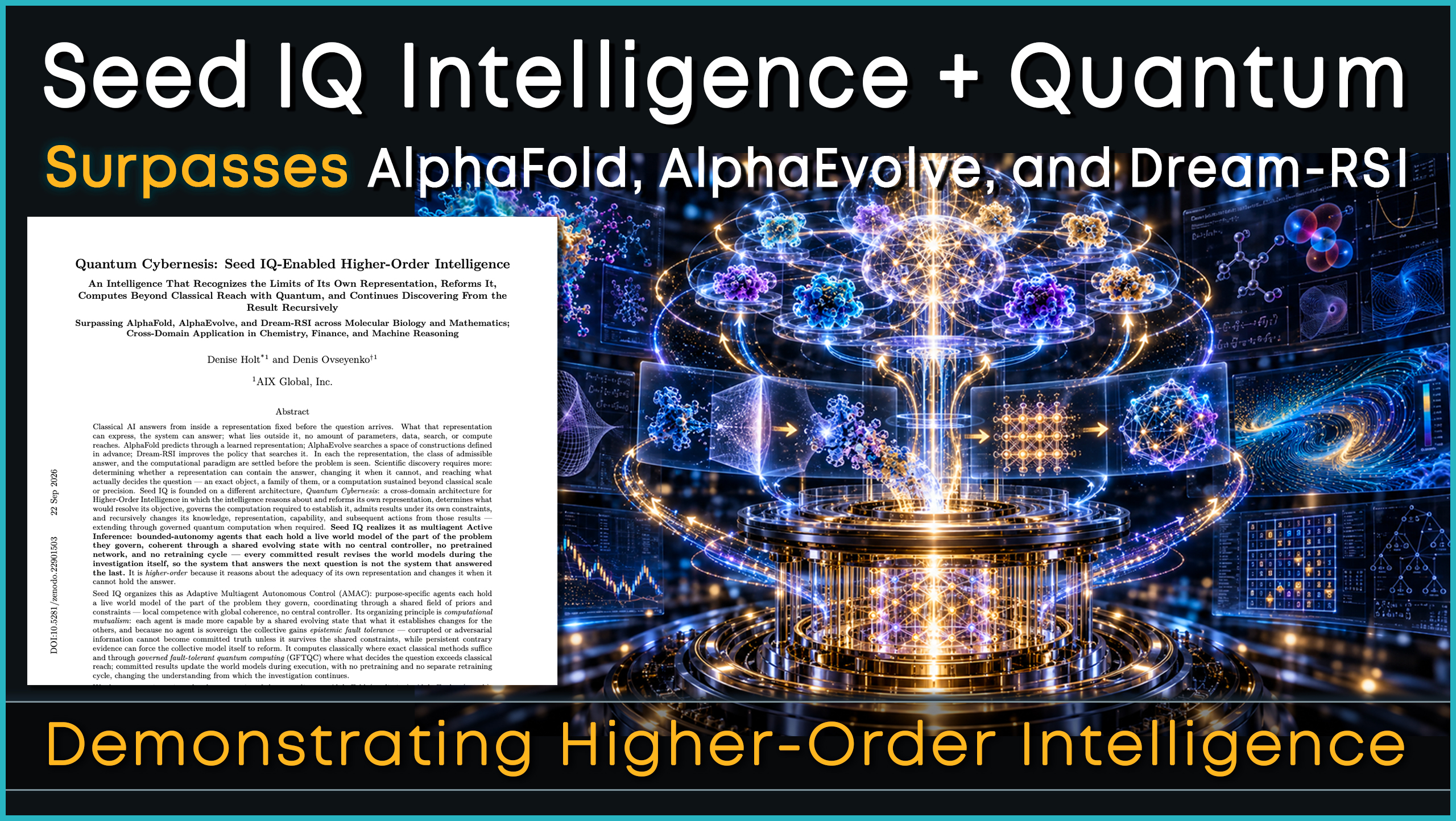
AIX Global’s Seed IQ Intelligence + Quantum architecture combines adaptive multiagent intelligence with Governed Fault-Tolerant Quantum Computing, demonstrated across AlphaFold, AlphaEvolve and Dream-RSI benchmarks as higher-order intelligence.
Seed IQ’s Intelligence + Quantum architecture enables adaptive AI to reform its own understanding and extend its knowledge beyond classical AI and computing.
The paper, “Quantum Cybernesis: Seed IQ-Enabled Higher-Order Intelligence,” evaluates Seed IQ across three established frontiers in scientific AI: Google DeepMind’s AlphaFold for prediction, AlphaEvolve for automated construction search, and Dream-RSI for recursive improvement of search. Rather than treating the systems as equivalent benchmarks, the study examines the architectural limit represented by each and tests whether Seed IQ can move beyond it.
In molecular biology, Seed IQ was tested on scientific questions that cannot be resolved by protein-structure prediction alone. On the fold-switching protein KaiB, Seed IQ first determined that the system required two physical folds, then correctly assigned all 26 of 26 experimentally determined conformers with their labels withheld. On the GB1 protein-fitness landscape, a fitted pairwise comparator reached R² = 0.6143, near the separate full-grid pairwise ceiling of 0.615. Seed IQ retained higher-order interaction structure and reached R² = 0.8835 on held-out prediction, then inverted the resulting landscape to recover FWAA, the experimentally measured optimum at 8.762 times wild-type activity.
The paper also tests Seed IQ against mathematics benchmarks released with AlphaEvolve. On Erdős discrepancy at C=2, Seed IQ extended the published construction from 380 to 520. In rank-48 complex 4×4 matrix multiplication, it retained all 48 multiplications while reducing the addition count from 1,264 to 404, with all 4,096 coefficients verified exactly. On the tighter C=1 Erdős discrepancy problem, Seed IQ established that length 11 exists and length 12 is impossible, converting a best-found construction problem into a proven boundary.
The significance of the study is architectural rather than simply a collection of higher benchmark scores. AlphaFold predicts within a learned representation. AlphaEvolve searches for stronger constructions. Dream-RSI goes further by recursively improving the strategy used to conduct that search. Each advances what can be predicted or discovered within a representation or search process already defined for the task. Seed IQ moves beyond that boundary. It can determine whether the representation itself is adequate, reform it when evidence shows that it is not, determine the exact scientific object required to resolve the question, and decide what computation, classical or quantum, should come next.
That is the higher-order capability demonstrated in the paper: recursion no longer acts only on the search process; it can act on the intelligence’s own scientific frame, understanding and computational reach.
That distinction becomes more consequential when the required object lies beyond classical computational reach. Seed IQ can extend the same reasoning process through Governed Fault-Tolerant Quantum Computing, then commit the computed result back into the intelligence’s shared scientific state. The result does not simply answer the current question; it can change what the system knows, how it represents the problem, and what it is capable of determining next.
“The significance is not simply that Seed IQ produced stronger results on individual benchmarks,” said Denise Holt, Founder and Chief Executive Officer of AIX Global. “It is that the intelligence can recognize when the framework it is using is insufficient, change that framework and, when necessary, reach beyond classical computation for the knowledge it needs. The quantum result then becomes part of the intelligence’s next state of understanding. That is what we mean by Intelligence + Quantum.”
AIX calls the governing architecture Quantum Cybernesis. It brings together multiagent Active Inference, organized through Adaptive Multiagent Autonomous Control (AMAC), with Governed Fault-Tolerant Quantum Computing (GFTQC). Both are breakthrough capabilities exclusive to AIX Global, and Seed IQ is the only intelligence architecture in which they operate together. The paper describes the capability produced by Intelligence + Quantum as Seed IQ’s higher-order intelligence: adaptive intelligence that can examine and reform its own understanding while extending the knowledge available to it beyond classical computational limits.
The paper also connects these results with AIX Global’s work across quantum chemistry, mathematical proof, financial risk, Navier-Stokes analysis, FeMoCo chemistry and ARC-AGI-3 machine reasoning, documenting the same Seed IQ architecture across multiple scientific domains.
Read the companion article: Seed IQ Intelligence + Quantum Surpasses AlphaFold, AlphaEvolve and Dream-RSI, Demonstrating Higher-Order AI
Denise Holt
AIX Global
info@aix.us.com
Legal Disclaimer:
EIN Presswire provides this news content "as is" without warranty of any kind. We do not accept any responsibility or liability for the accuracy, content, images, videos, licenses, completeness, legality, or reliability of the information contained in this article. If you have any complaints or copyright issues related to this article, kindly contact the author above.
